
Climbing the BIM Maturity Ladder: A Walkthrough for Project Teams
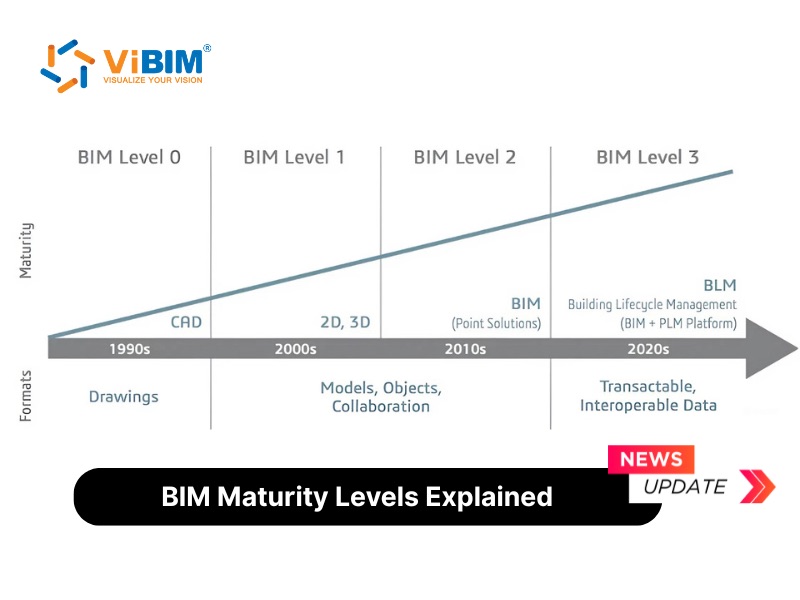
Every project team reaches a point where someone asks a plain question: how well do we actually share information? The four-level maturity scale gives a way to answer that question with evidence instead of opinion. This walkthrough follows a team as it checks its own position, one level at a time.
The first check is the simplest. If each discipline still works from its own 2D drawings, exchanges files as separate documents and has no common repository, the team sits at Level 0. There is no digital representation of the building, and the risk of errors and rework runs high. Few teams stay here by choice, because the industry has largely moved past this practice.
The next check looks for a Common Data Environment. A CDE is a central online place where project information is stored and shared. When a team mixes 2D and 3D data, follows British Standard BS 1192:2007 for its CAD work and keeps a CDE, it has reached Level 1. The catch is that each discipline still creates and manages its own data, so models rarely travel between parties. That is why some people call this stage "lonely BIM".
The third check is where most of the value sits. A team at Level 2 keeps separate disciplinary models but merges them into a federated model inside the CDE. Project partners then run clash detection and design review in one coordinated view. Exchange relies on open formats, mainly IFC and COBie. Teams that coordinate work through ACC BIM workflows often use this stage as their working baseline. It is also the point where 4D scheduling and 5D cost estimation become fully workable, and the UK made it mandatory for centrally procured public projects by April 2016.
The last check is rare. At Level 3 the federated models give way to a single shared project model in the cloud. Changes appear for everyone in real time, and the model follows the building from design through operation, maintenance and disposal. This is the stage that supports 6D sustainability and 7D facility management uses.
Maturity says nothing about model detail. A short note on terms helps here. Maturity levels measure collaboration. BIM dimensions describe the type of data added to a model, such as time or cost. Level of development, or LOD, describes how detailed and reliable each element is at a given stage. A scope of work that mixes them up can change both the deliverable and the price.
Two practical lessons come out of the walkthrough. First, the main barrier to moving up is usually culture and process, not software. Teams must shift from siloed, adversarial habits to open collaboration, and they must pay for training and agree repeatable processes across the supply chain. Second, higher levels depend on clean inputs. Collaboration breaks down when the underlying data is inconsistent, so a verified as-built model is a sound foundation.
For a full explanation of each level, the benefits of moving up and the role of ISO 19650, read the original article on levels of BIM maturity, which lays out the whole framework in one place.