
Verifying a Supermarket Model When the Whole Chain Is Waiting
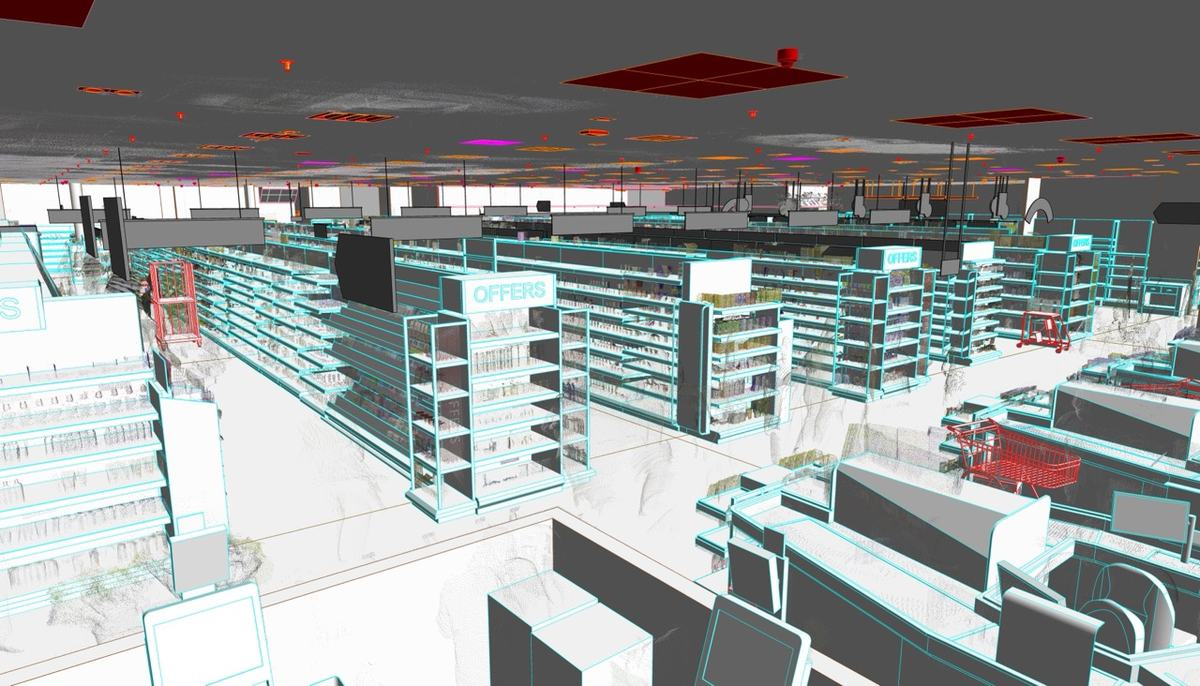
Verification looks different when a model is one of seven. A late error in one store does not only delay that store, it can ripple into the rest of the program. This note walks through how the checks were arranged on a two-floor UK supermarket of roughly 14,000 m², modeled between 19 July and 16 August 2023.
The team received a point cloud and 2D drawings, and the brief asked for architecture, structure and MEP between LOD 300 and LOD 400. Before any modeling started, the team separated the work into streams. New stores, urgent revisions and quality control each got their own lane, so a rush on one never starved the others. For owners who want the same discipline across their own sites, our point cloud to BIM services follow the same idea of agreeing the standard before the first object is placed.
Modeling used a standardized LOD 400 family library. Because every family had to come from the client's own library, new components were built in place or edited only when nothing suitable existed. That kept the model consistent with the other stores in the program.
Verification ran in layers. An internal renaming tool first removed manual naming errors, which are the most common cause of data mismatches. Dedicated in-house software then swept the whole project for missing objects, gaps and clashes. Manual checks followed, and they were repeated, because automated sweeps find what they are told to find and a reviewer finds the rest. The model was held within ±15 mm (±0.6 in) of the scan data.
Revisions to stores that had already been handed over were gathered into larger batches. Before fixing an error, the team asked where it started: the scan data, a family, or a misread requirement. The answer went back into the standard, so the next store began with that mistake already closed.
The full specification, challenges and results are on the project page for Revit modeling for a UK supermarket chain. It lists inputs, software and deliverables alongside the business impact.
The result was a store completed inside its window and handovers that stayed continuous across the program. The client kept its planned opening schedule for new locations.
The practical rule is short. Check in layers, batch your interruptions, and write every lesson back into the standard before the next store begins.